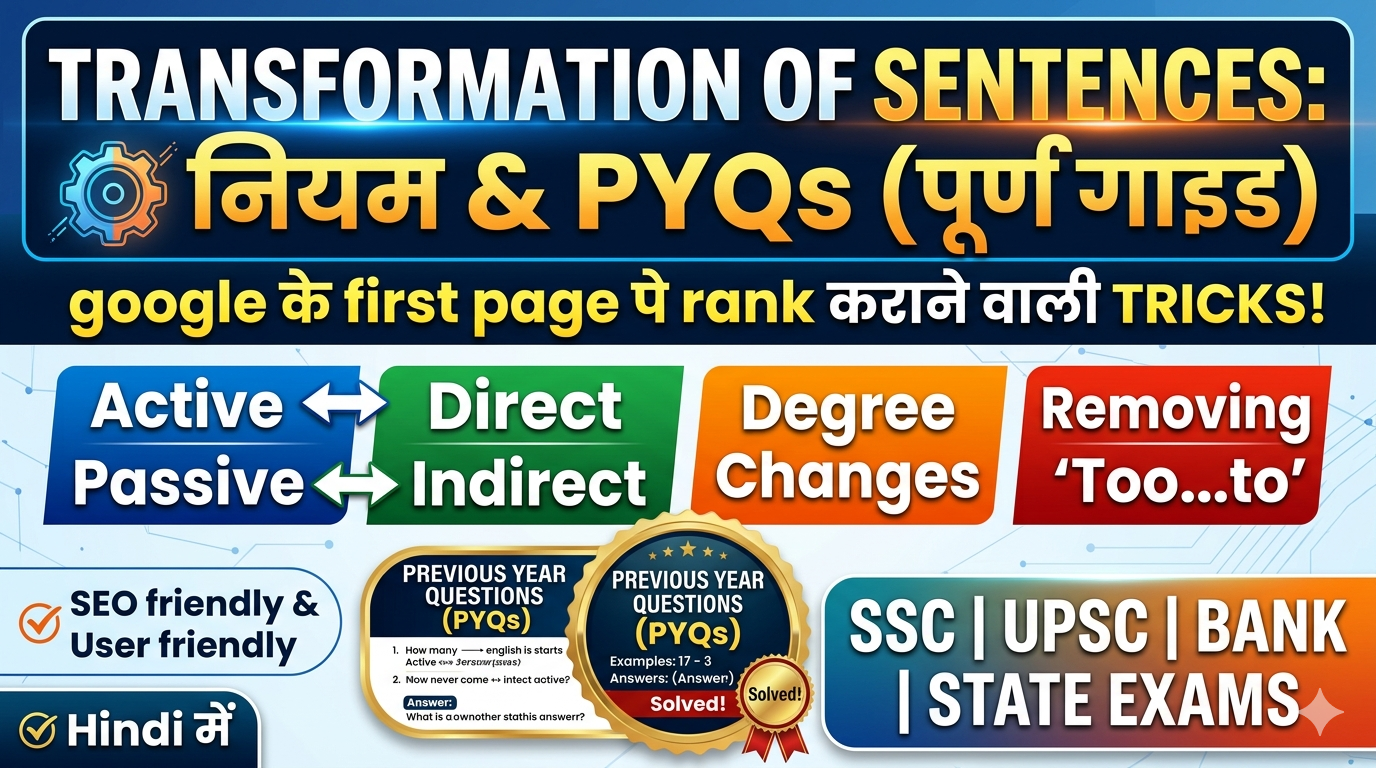
English Grammar में Transformation of Sentences एक ऐसा महत्वपूर्ण अध्याय है, जिससे लगभग हर प्रतियोगी परीक्षा (जैसे SSC CGL, CHSL, Teaching Exams, और State PSC) में प्रश्न पूछे जाते हैं।
इस ब्लॉग में हम न केवल इसके नियमों को समझेंगे, बल्कि पिछले वर्षों के प्रश्नों (PYQs) का भी अभ्यास करेंगे ताकि आप परीक्षा में 100% स्कोर कर सकें।
Transformation of Sentences क्या है?
वाक्यों के रूप को बदलना (Transformation) का अर्थ है—किसी वाक्य के व्याकरणिक ढांचे (Grammatical Structure) को इस तरह बदलना कि उसका अर्थ (Meaning) न बदले।
Results


#1. Choose the correct option changing the following sentence into assertive: What a delicious food! [LDC-09.09.2018]
जब हम “What a/an” से शुरू होने वाले विस्मयादिबोधक वाक्यों को साधारण वाक्यों में बदलते हैं, तो तीव्रता (intensity) को दर्शाने के लिए हम ‘very’ या ‘great’ जैसे शब्दों का प्रयोग करते हैं।
Exclamatory: “What a delicious food!” (कितना स्वादिष्ट भोजन है!)
Assertive Rule: Subject + Verb + very + Adjective + Noun.
Transformation: “It was a very delicious food.”
#2. Choose the correct exclamatory form of the following sentence from the given options: He is a great doctor. [LDC-09.09.2018]
यह प्रश्न एक Assertive Sentence (साधारण कथन) को Exclamatory Sentence (विस्मयादिबोधक वाक्य) में बदलने के बारे में है। जब किसी वाक्य में ‘a great’ या ‘a very’ जैसे शब्दों का प्रयोग होता है, तो उसे Exclamatory बनाने के लिए ‘What a’ संरचना का उपयोग किया जाता है।
Assertive Structure: Subject + Verb + a + great/very + Adjective/Noun.
Exclamatory Rule: What a + Adjective + Noun + Subject + Verb + !
Quick Conversion Table for Exams
| Assertive | Exclamatory |
| He is a very kind man. | What a kind man he is! |
| It is a great victory. | What a victory it is! |
| The weather is very nice. | How nice the weather is! |
#3. Choose the correct transformation from exclamatory to assertive: [LDC-09.09.2018] What a wonderful creature an elephant is!
-
Exclamatory Sentence: “What a wonderful creature an elephant is!” (हाथी कितना अद्भुत प्राणी है!)
Rule:
वाक्य के अंत में आए Subject (An elephant) और Verb (is) को सबसे पहले लाएं।
‘What a’ को हटाकर ‘a very’ का प्रयोग करें।
शेष विशेषण और संज्ञा (wonderful creature) को अंत में जोड़ें।
Transformation: “An elephant is a very wonderful creature.“
#4. Choose the correct option from Assertive to Exclamatory transformation for the sentence given. [LDC-09.09.2018] I wish I had wings of a dove.
जब हम “I wish…” (मेरी इच्छा है…) से शुरू होने वाले Assertive वाक्यों को Exclamatory में बदलते हैं, तो तीव्र इच्छा (strong desire) प्रकट करने के लिए विशेष शब्दों का प्रयोग किया जाता है।
Original Sentence: “I wish I had wings of a dove.” (काश मेरे पास कबूतर जैसे पंख होते।)
Rule: “I wish” वाले वाक्यों को विस्मयादिबोधक बनाने के लिए “O that”, “Oh that”, “If only” या “Would that” का प्रयोग किया जाता है।
Transformation: “O that I had wings of a dove!“
#5. Choose the correct conversion from interrogative to assertive: [LDC-09.09.2018] Was he not a hero to do such a deed?
जब भी Interrogative से Assertive बनाना हो:
अगर प्रश्न Negative (Was he not…?) है, तो Assertive Positive बनेगा।
अगर प्रश्न में किसी महान कार्य की बात हो, तो अक्सर ‘Only’ या ‘None but’ जैसे शब्दों का प्रयोग करके उसे Assertive बनाया जाता है।
उदाहरण:
Interrogative: Who does not know Mahatma Gandhi?
Assertive: Everyone knows Mahatma Gandhi.
#6. Choose the correct option for Assertive to Negative transformation for the sentence given. [LDC-16.09.2018] As soon as he came he made objections.
यदि प्रश्न में As soon as + $V_2$ (जैसे: came) दिखे, तो उत्तर में इन दो पैटर्न को खोजें:
No sooner + did + Sub + $V_1$ … than …
No sooner + had + Sub + $V_3$ … than …
#7. Which of the following is the most apt conversion from affirmative to negative? Everybody was present. [LDC-16.09.2018]
जब हम Affirmative (सकारात्मक) वाक्य को Negative (नकारात्मक) में बदलते हैं और हमें अर्थ समान रखना हो, तो हम “Antonym” (विलोम शब्द) के साथ नकारात्मक शब्द का प्रयोग करते हैं।
Original Sentence: “Everybody was present.” (हर कोई उपस्थित था।)
Logic: यदि हर कोई उपस्थित था, तो इसका मतलब है कि कोई भी अनुपस्थित (absent) नहीं था।
Transformation Rule:
Everybody बदल जाता है Nobody में।
Present (उपस्थित) बदल जाता है उसके विलोम Absent (अनुपस्थित) में।
#8. Choose the correct option for Negative to Assertive transformation for the sentence given: No one can deny that she was pretty. [LDC-16.09.2018]
यह प्रश्न Negative (नकारात्मक) वाक्य को Assertive/Affirmative (सकारात्मक) में बदलने के बारे में है। जब “No one” और “Deny” (अस्वीकार करना) जैसे दो नकारात्मक शब्दों का प्रयोग एक साथ होता है, तो वे मिलकर एक सकारात्मक अर्थ देते हैं।
Original Sentence: “No one can deny that she was pretty.” (कोई इस बात से इनकार नहीं कर सकता कि वह सुंदर थी।)
Logic: यदि कोई इनकार नहीं कर सकता, तो इसका मतलब है कि हर कोई स्वीकार करता है।
Transformation Rules:
No one बदल जाता है Everyone/Everybody में।
Deny (अस्वीकार करना) बदल जाता है उसके विलोम Admit (स्वीकार करना) या Accept में।
चूँकि “can deny” एक सामान्य सत्य या विचार बता रहा है, इसलिए Assertive में इसे Present Simple (admits) में रखा जाता है।
#9. Choose the correct assertive form of the following sentence from the given options: They did not sign the paper. [LDC-16.09.2018]
यह प्रश्न एक Negative (नकारात्मक) वाक्य को Assertive/Affirmative (सकारात्मक) में बदलने के बारे में है। रूपांतरण का सबसे महत्वपूर्ण नियम यह है कि वाक्य का Tense (काल) नहीं बदलना चाहिए।
Original Sentence: “They did not sign the paper.”
Tense Identification: यहाँ ‘did not + $V_1$‘ का प्रयोग हुआ है, जो दर्शाता है कि वाक्य Past Indefinite Tense में है।
Assertive Rule (Past Indefinite): सकारात्मक वाक्य में ‘did’ हट जाता है और मुख्य क्रिया की Second Form ($V_2$) का प्रयोग होता है।
Structure: Subject + $V_2$ + Object.
Transformation: They + signed + the paper.
#10. Choose the correct option changing the following sentence into exclamatory. She sings very sweetly. [LDC-16.09.2018]
यह प्रश्न एक Assertive (साधारण) वाक्य को Exclamatory (विस्मयादिबोधक) में बदलने के बारे में है। जब किसी वाक्य में ‘very’ के बाद कोई Adverb (जैसे: sweetly) या Adjective (जैसे: sweet) आता है, तो उसे Exclamatory बनाने के लिए ‘How’ का प्रयोग किया जाता है।
Assertive Structure: Subject + Verb + very + Adverb/Adjective.
Exclamatory Rule: How + Adverb/Adjective + Subject + Verb + !
#11. Choose the correct option changing the following sentence into exclamatory: It is a matter of praise that he has won the trophy. [LDC-16.09.2018]
जब हम किसी Assertive (साधारण) वाक्य को Exclamatory (विस्मयादिबोधक) में बदलते हैं, तो वाक्य में छिपी हुई भावना (Emotion) को पहचानना सबसे महत्वपूर्ण होता है।
Original Sentence: “It is a matter of praise that he has won the trophy.” (यह प्रशंसा की बात है कि उसने ट्रॉफी जीती है।)
Key Phrase: “A matter of praise” (प्रशंसा की बात)।
Rule:
Praise (प्रशंसा) के लिए विस्मयादिबोधक शब्द ‘Bravo!’ का प्रयोग किया जाता है।
Joy (ख़ुशी) के लिए ‘Hurrah!’ का प्रयोग किया जाता है।
Sorrow (दुख) के लिए ‘Alas!’ का प्रयोग किया जाता है।
#12. Choose the correct interrogative transformation of the given assertive sentence: It does not matter much though we happen to be late. [LDC-16.09.2018]
| Assertive Pattern | Interrogative Pattern |
| It does not matter though… | What though…? |
| It is no use… | What is the use of…? |
| It is a pity… | Isn’t it a pity…? |
| There is no… | Who is there…? / Is there any…? |
मुख्य रूप से इसमें निम्नलिखित बदलाव शामिल होते हैं:
- Interchange of Active and Passive Voice.
- Interchange of Direct and Indirect Speech.
- Interchange of Degrees of Comparison (Positive, Comparative, Superlative).
- Interchange of Affirmative and Negative Sentences.
- Removal of ‘Too’.
1. Interchange of Degrees of Comparison
परीक्षाओं में अक्सर Degree बदलने के प्रश्न आते हैं।
- Positive: No other city in India is as big as Mumbai.
- Comparative: Mumbai is bigger than any other city in India.
- Superlative: Mumbai is the biggest city in India.
Pro Tip: यदि वाक्य में ‘One of the’ का प्रयोग हो, तो Comparative में ‘Most other’ का प्रयोग करें।
2. Removal of Adverb ‘Too’
जब वाक्य में ‘Too…to’ का प्रयोग होता है, तो उसे ‘So…that’ में बदला जाता है।
- Example: He is too weak to walk.
- Transformation: He is so weak that he cannot walk.
3. Affirmative to Negative (बिना अर्थ बदले)
यह सबसे ट्रिकी हिस्सा है। यहाँ हम विलोम शब्दों (Antonyms) का प्रयोग करते हैं।
- Affirmative: He is a wise man.
- Negative: He is not a foolish man. (अर्थ वही रहा)
Transformation of Sentences: Previous Year Questions (PYQs)
यहाँ कुछ महत्वपूर्ण प्रश्न दिए गए हैं जो पिछली परीक्षाओं में बार-बार पूछे गए हैं:
Q1. Change into Negative: “As soon as the thief saw the police, he ran away.”
- Answer: No sooner did the thief see the police than he ran away.
Q2. Change the Degree: “Iron is more useful than any other metal.” (Into Superlative)
- Answer: Iron is the most useful metal.
Q3. Remove ‘Too’: “The tea is too hot for me to drink.”
- Answer: The tea is so hot that I cannot drink it.
Q4. Interrogative to Assertive: “Who can touch the sky?”
- Answer: No one can touch the sky.
निष्कर्ष (Conclusion)
Transformation of Sentences पर पकड़ बनाने का सबसे अच्छा तरीका है—ज्यादा से ज्यादा अभ्यास। ऊपर दिए गए PYQs आपकी समझ विकसित करने में मदद करेंगे। अगर आप किसी विशेष नियम के बारे में विस्तार से जानना चाहते हैं, तो नीचे कमेंट करें!